Designing for Intelligent Efficiency: How to Build the Operating Model Behind Modern Transformation
Making Intelligent Efficiency real.

The Evolution So Far
In the first two articles of my series on Intelligent Efficiency, we explored how organizations can evolve from doing more with less to operating smarter, not just faster. I introduced Intelligent Efficiency as the next-generation operating principle and the strategic balance between speed, intelligence, and intent. I also shared the five stages of maturity evolution and how organizations progress towards true Intelligent Efficiency.
Understanding the idea of Intelligent Efficiency is one thing, and making it real (and sustainable) is another. Transformation doesn’t just happen when you buy new AI technology or simplify a few processes, it happens when the operating model (i.e. how your organization operates, learns, decides, and scales) evolves with where your customers are going.
In this third part of the series, I’m excited to shift the focus from what Intelligent Efficiency is to how to design for it.
Why Most Transformations Don’t Stick
Transparently, most organizations fail at transformation because the operating model was never designed to evolve. We can’t plug AI into legacy ways of working and expect magic. We also can’t measure success through traditional efficiency KPIs and expect modern transformation and intelligent efficiency. And we definitely can’t evolve at market speed with fragmented teams, static governance and disconnected insights.
The core challenge for today’s leaders isn’t just to adopt modern technology like AI, it’s to design intentionally for it. That means building systems and empowering teams that learn and adapt fast, and cultures that value precision as much as speed.
Self-Diagnosis: Where Are You on the Curve?
Before redesigning your operating model, you need to know your current reality and how it maps to the Intelligent Efficiency Maturity Model. Ask yourself (and your teams) the following questions across the four core dimensions.
1. How You Operate
Are your workflows connected or siloed?
Do teams understand why they do the work, or just what to deliver?
Is governance enabling faster, smarter work or creating bottlenecks?
2. How You Learn
Do insights fuel decision-making in real time (or at least in a relevant and timely manner)?
Are teams empowered to experiment, learn, and share their lessons learned (rather than lessons learned dying in PowerPoint)?
Is AI used to help identify patterns and predict outcomes, or just to generate dashboards about what happened in the past?
3. How You Decide
Who makes majority of the decisions: committees/leaders, empowered teams or AI?
Do data and insights inform strategy, or just report on performance?
Are ethical considerations built into decisions by design, or considered afterwards (and sometimes too late)?
4. How You Scale
Can successful experiments be replicated across teams quickly?
Are your platforms, data, and governance scalable without slowing down delivery of value?
Does the organization’s culture celebrate adaptation and learning as progress or view change purely as chaos?
The answers to the above questions help you locate where you are on the maturity curve from Reactive to Intelligently Efficient. More importantly, they start to highlight what to evolve in your operating model.
The 4 Key Drivers of Evolution
Intelligent Efficiency isn’t the result of one team, an isolated effort, or a single tool. It takes shape when Strategy, Data, AI, and People evolve as one connected system. And when those core drivers finally align, Intelligent Efficiency stops being a project and becomes the organization’s natural operating state — the way work flows, decisions accelerate, and value gets created and delivered with precision and purpose.
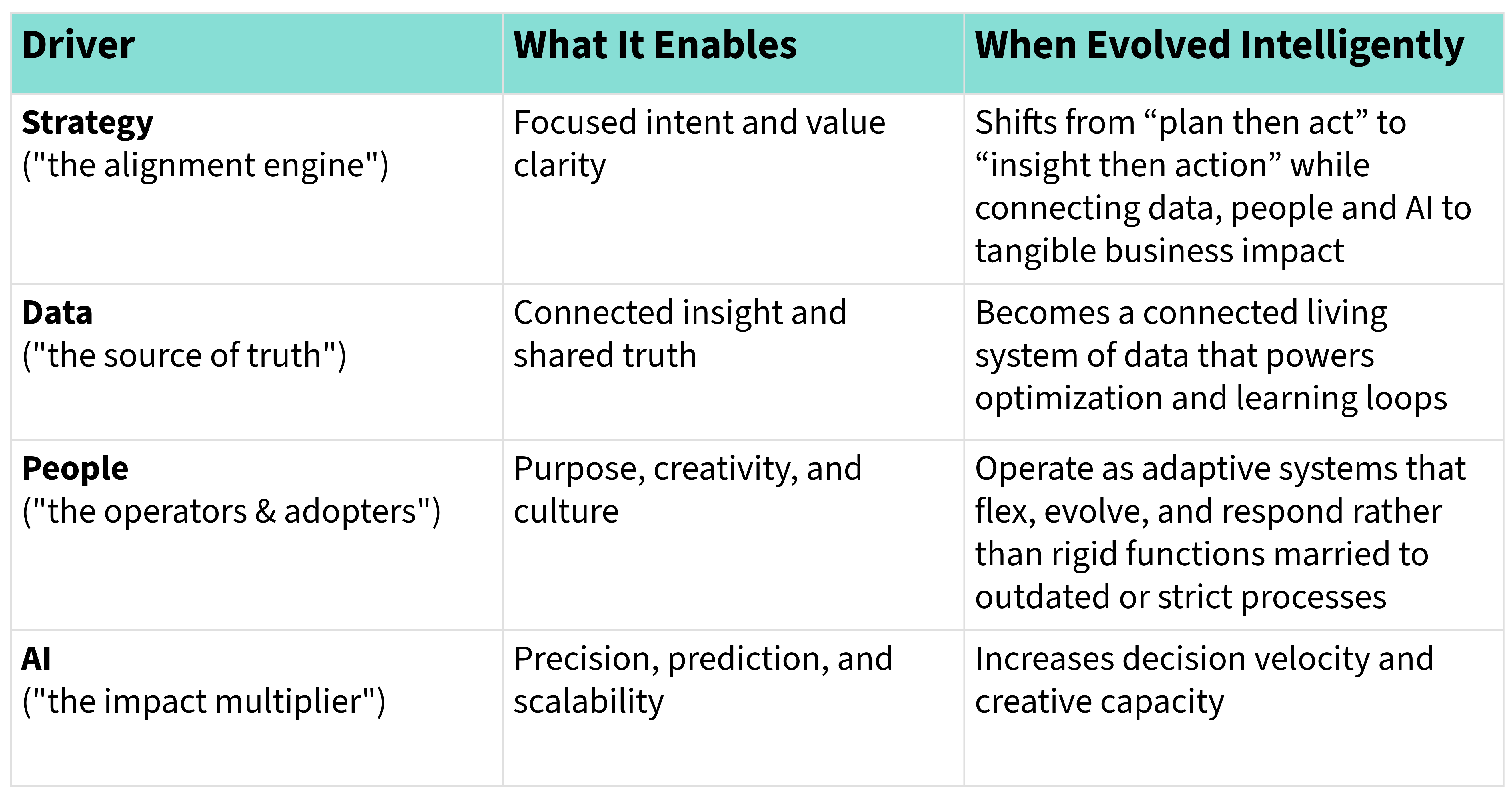
In a nutshell, data and AI can accelerate you but strategy determines where you’re going. Strategy makes sure every initiative, investment and workflow drives value and the desired business outcomes; otherwise, you may end up with a lot of activity with little or no impact. Evolving strategy means reorienting priorities around measurable outcomes, aligning resources to impact and building operating rhythms that reinforce focus on the right outcomes.
Additionally, if data isn’t accurate, accessible and governed, you can’t automate, optimize or personalize anything. To evolve data, leaders must shift from fragmented, inconsistent data foundations to reliable, connected, governed ecosystems. And people are the ones who need to trust the data as well as adopt AI and adapt their behaviors; if they don’t evolve, nothing else matters as technology doesn’t transform organizations, people do. Evolving people means mindsets that embrace experimentation, skills built around data and AI and structures aligned to outcomes rather than silos.
Finally, AI is what transforms data into action and good intentions into scalable efficiency with predictions, recommendations, automation and optimization; but AI only delivers “intelligent” outcomes when it’s tied to strategy, grounded in good data and designed around human workflows (in other words, AI collapses fast without strategy, data and people supporting it).
Every barrier to Intelligent Efficiency maps back to at least one of these drivers and every lever for change sits under one of these drivers.
The Organizational Levers To Make the Shift
Think of the Drivers as “what powers Intelligent Efficiency” while the Organizational Levers help evolve each Driver as mechanisms (or handles) for change. Leaders must adjust the levers to evolve the org’s capabilities, enable adoption and unlock Intelligent Efficiency. Each lever should answer: “If we want this driver to perform better (or yield better outcomes), what parts of the org or the way we work might we need to shift or mature?”
Levers to Evolve Strategy:
Portfolio & Prioritization Processes:
Shift from reactive or legacy-driven initiatives to outcome-driven
Consider evolving how initiatives are evaluated, sequenced, and funded
Performance & Metrics:
Align on KPIs that measure and drive Intelligent Efficiency, impact, and adoption
Operating Rhythms & Cadences:
Establish regular and timely review cycles and alignment cadences (with a lean cross-functional steering committee when necessary)
Innovation & Experimentation:
Enable the ability to test, learn, and scale new approaches and ways of working
Levers to Evolve Data:
Data Governance & Ownership:
Define who owns what data, establish quality standards, and create accountability (i.e. stewardship) of data
Data Integration & Architecture:
Embed data into decision-making processes across teams
Move from siloed systems to connected, interoperable data platforms and pipelines across systems
Analytics Enablement:
Enable self-service analytics and dashboards, and ensure KPIs are accessible to teams (both baseline and target metrics)
Data Access & Literacy:
Ensure people have access to the data they need and know how to interpret and action on it
Levers to Evolve People:
Org Structure & Roles:
Move toward cross-functional pods or agile teams aligned to outcomes
People Skills & Org Capabilities:
Create enablement and upskilling programs to build a workforce that can operate in a data and AI-enabled world (where data literacy and AI fluency are critical to the new ways of working)
Culture & Mindset:
Shift incentives, recognition, and behaviors (including creating psychological safety) to encourage experimentation and intelligent efficiency
Collaboration & Decision Rights:
Clarify who decides what (especially when AI augments decisions) and enable faster, more informed decision-making and cross-team collaboration
Levers to Evolve AI:
AI Strategy & Use Case Prioritization:
Shift from adhoc AI experiments to the AI use case activation through prioritized AI initiatives aligned to business outcomes
AI Model Development & Operations:
Improve processes for operationalizing AI (e.g., building, testing, deploying, and scaling AI models)
AI Ethics & Governance:
Embed ethics, compliance guardrails and bias controls for responsible AI usage and adoption
AI Change Management & Adoption:
Embed AI into teams’ workflows and encourage AI adoption so teams actually use it
When any one driver lags, efficiency slows. But when they evolve together, performance accelerates exponentially.
No single driver can deliver Intelligent Efficiency on its own. Data without AI is essentially unused potential while AI without people is unused capability. People without strategy are unfocused and overwhelmed by undefined or ever-changing priorities. And strategy without data is guesswork dressed up as direction and clarity.
Closing Thought
Now, you may be wondering about the mention of Operating Model as a key driver (or lever) but an Intelligent Efficiency operating model is actually the outcome of evolving the four drivers mentioned earlier. The strategy, data, people and AI produce the future operating model.
Intelligent Efficiency is about synchronizing the clarity of your direction (strategy), the quality of your inputs (data), the capabilities and skills of your org (people) and the power of your technology (AI). When these four evolve together, efficiency becomes “intelligent” instead of just cost-cutting. These drivers determine whether an organization works harder...or smarter.
I’d love to hear from you:
What levers have you been pulling to evolve your operating model?
What levers should you be pulling?
This article is part 3 of my ongoing Intelligent Efficiency series — a practical guide for leaders building the next generation of adaptive, AI-powered organizations.
Up next in this series: The Blueprint for Modern Operating Models